Detroit Mission: Glider Assault
Two 57mm Anti-Tank Guns West of the Merderet

While Detroit Mission CG-4A Gliders lined up in order along the Ramsbury tarmac, the integrity of the formation deteriorated from almost the very beginning of the glider assault on Normandy.
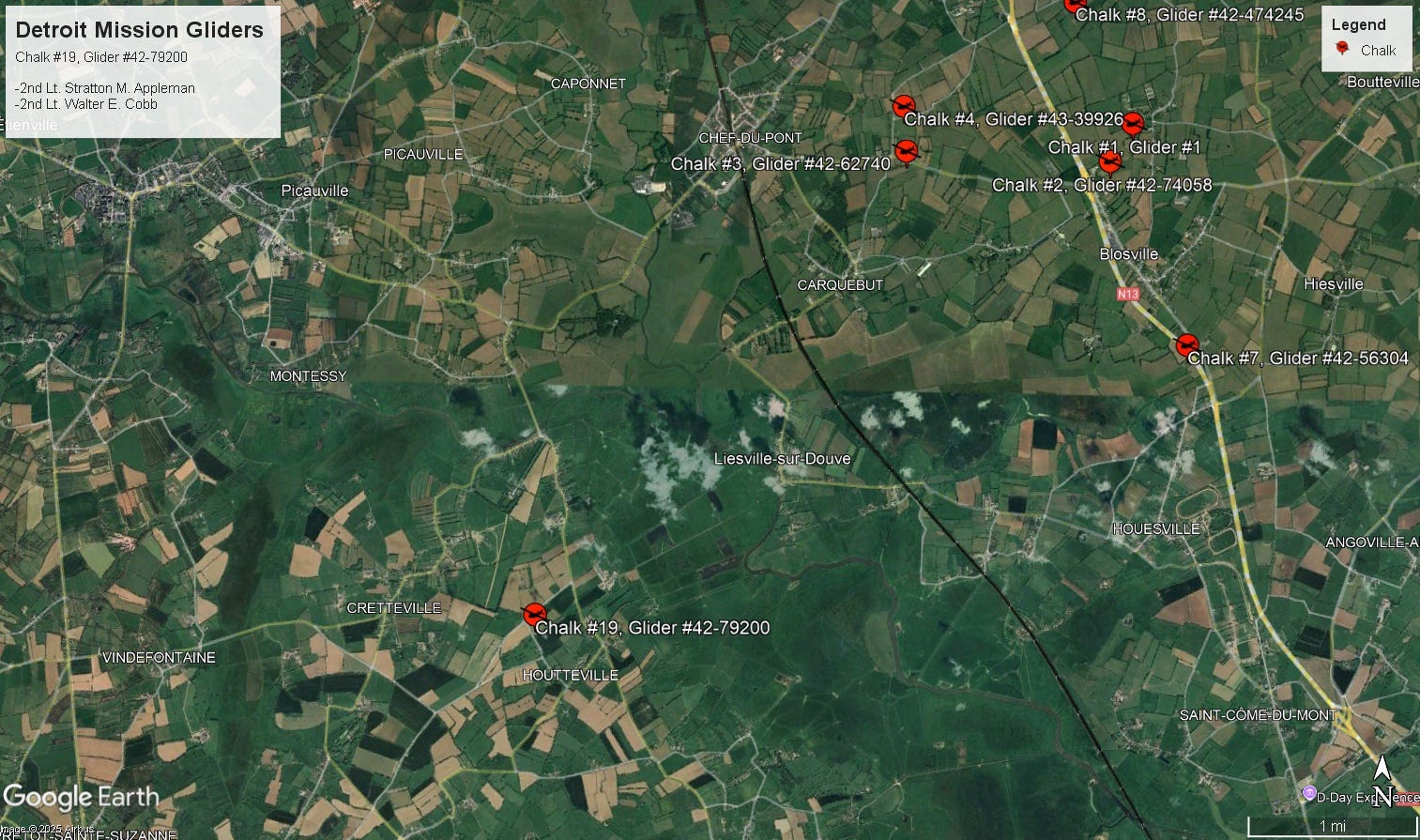
Chalk #19
The muzzle of a 57mm anti-tank gun jutted into the greenhouse of Waco CG-4A Glider 42-79200. The mass of the 2500-pound weapon posed an extreme crushing hazard upon landing even if properly secured. Pre-flight checks of the cargo tiedowns, the nose hitch, and the nose latch complete, glider pilots 2nd Lt. Stratton M. Appleman and 2nd Lt. Walter E. Cobb waited for takeoff along with three gunners from the 82nd Airborne’s Battery B, 80th Airborne Anti-Aircraft Artillery Battalion. All five men in the glider were nervous and impatient to get rolling down the runway and then aloft—on their collective way to Normandy. In the cockpit of C-47 42-100660, Capt. Richard E. Cathcart and 2nd Lt. Melvin W. Kostich throttled the engines up and the plane began moving forward, taking up the slack in the nylon tow rope between the aircraft pairing. “There was a snap and a lurch, and we were hurtling down the runway almost at flying speed,” described Appleman. The three soldiers of the 80th Anti-Aircraft Artillery Battalion began yelling and pointing at the two-foot gap opening in the floor between the glider’s nose and fuselage. The pilots began swinging out in front of the glider as the top hinges of the cockpit were the only things holding the rig together. Air rushed into the glider’s fuselage. If the top hinges snapped as the latch had just done, the cockpit would have broken away from the rest of the glider, and the pilots would be dragged, tumbling behind the C-47. Appleman recognized the situation and reacted quickly.
“I grabbed the release and eased off the runway, then braked to a stop,” explained Appleman, the lead glider pilot of Chalk #19. Cathcart and company pulled away from the ailing glider, taking to the air, almost immediately turning their “Gooney Bird” back to the airfield. Flight Officer James Dunn, Jr. of the 85th Troop Carrier Squadron, ran to their aid and wired the broken nose-hatch shut in only moments. Cathcart and Kostich, brought their C-47 around again, landed, and began to taxi toward the glider. Appleman and Cobb were on the ground, speaking with Col. Donald J. French, ascertaining their next best course of action. The dilemma of Chalk #19 stemmed from attempting to fly the mission safely alone as every minute on the ground meant the 80th Airborne Anti-Aircraft Artillery Battalion’s Cpl. William E. Nutter, Pfc. Lee E. Parson, Pvt. Frank F. Skufca, along with their much-needed 57mm anti-tank gun fell further behind in arriving on the battlefield in Normandy.
In planning, Gen. Matthew B. Ridgway, 82nd Airborne Division Commander and Lt. Col. Raymond E. Singleton, 80th Airborne Anti-Aircraft Artillery Battalion Commander, had prioritized two batteries of the battalion comprising 16 of the versatile 57mm anti-tank guns and their crews to land via glider to bolster the paratroopers who had landed only hours earlier on the Cherbourg Peninsula. The integration of this first glider deployment of the 80th Airborne Anti-Aircraft Artillery Battalion’s 57mm anti-tank gun elements and the battle-hardened paratroopers of the 505th Parachute Infantry Regiment was deemed so important by Ridgway that he appointed Maj. Al Ireland, a veteran of two combat jumps, as the liaison between the two units—directing the experienced paratrooper to land by glider, secure the weapons, and employ them where most needed. Ireland’s challenge manifested in the fact that of the 13 serviceable-upon-landing 57mm anti-tank guns, only one landed directly on Landing Zone O during Detroit Mission. The other remaining 12 functional weapons were distributed between 500 yards and 20 (perhaps more) miles from their originally intended target.
The 82nd Airborne Divisions Glider Analysis/Statistical Study, date July 29, 1944, is misleading when not considering time and distance pertaining to the events of June 6-10, 1944. Six of the prized 57mm anti-tank guns to be delivered during Detroit Mission, landed far to the west of the Merderet River, in distant, German-held territory, remaining no consequence in the defense of Sainte-Mère-Église, Neuville-au-Plain, Chef du Pont, or La Fière. The supporting jeeps and ammunition trailers deployed in the associated gliders of Detroit Mission landed demonstrating a similar, and debilitating scattering. Chalk #35 managed to deliver the payload of a 57mm anti-tank gun and three-gun crewmembers directly to Landing Zone O, and Chalk #19 was still 15-minutes behind the rest of the formation. While some, like Chalk #35’s glider pilot, 1st Lt. Erle H. Wildermuth with co-pilot Flight Officer Edgar G. Theus by his side, landed Glider #43-36719 on time and on target, glider and cargo intact, other gliders were either already on the ground or circled in the chaos above the Cherbourg Peninsula. The question remained as to if the 57mm anti-tank gun in Chalk #19 would arrive within reach of 82nd Airborne Division soldiers, but it seemed Capt. Norman Nelson, commander, Battery A, 80th Airborne Anti-Aircraft Artillery Battalion, rather than Ireland, provided the more immediate answers in rounding up the guns available and employing them on the east side of the Merderet.
Chalk #38
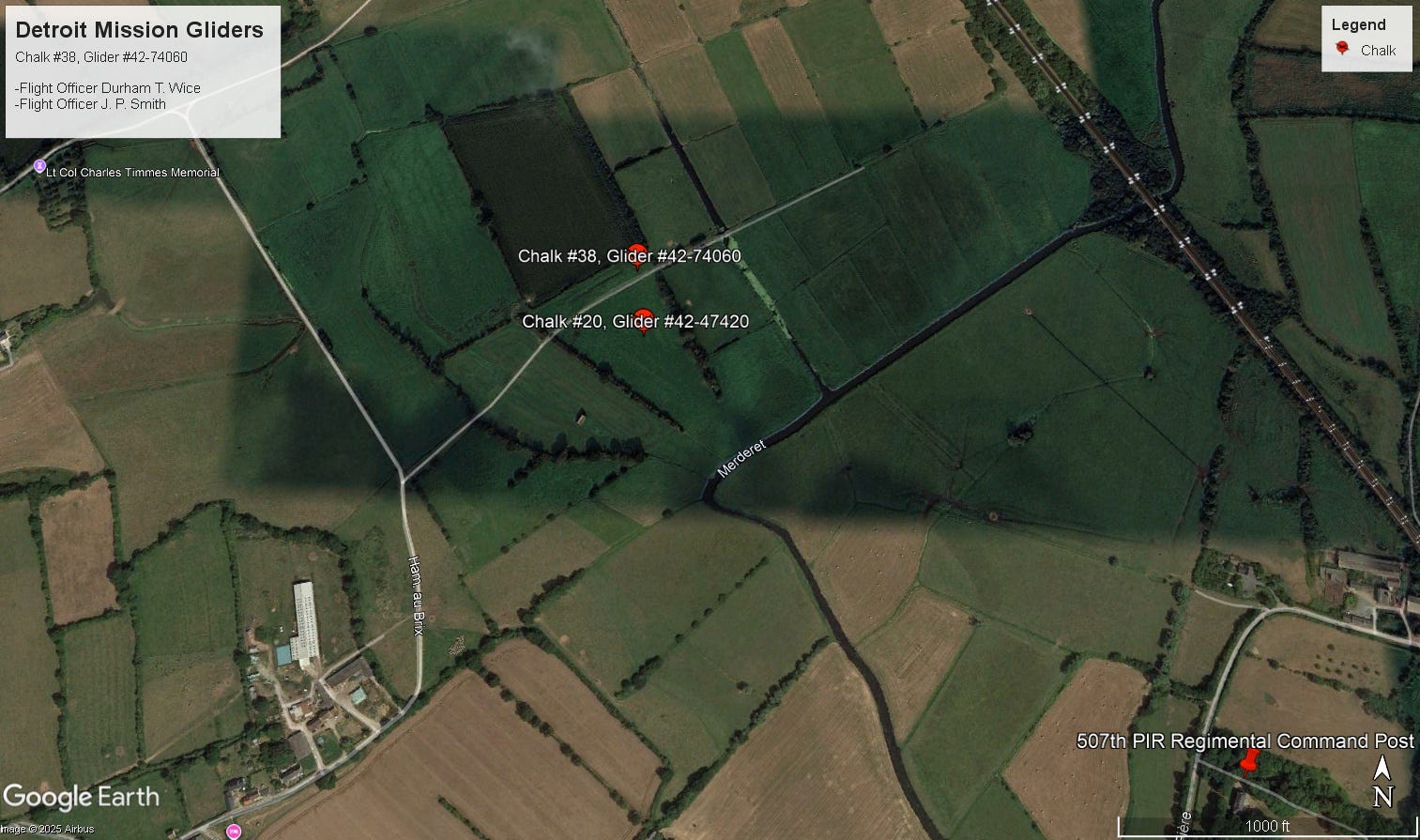
The second C-47 in the tenth echelon of Detroit Mission, pushed into the foggy wall over Normandy’s west coast, following 36 of the tug and glider pairings originating in Ramsbury. Even Chalk #19, although they were now 15 minutes behind the main body, had managed to get off the ground after convincing French to let them take off again. Capt. Fred W. Wurst piloted the C-47 towing a Waco CG-4A glider piloted by Durham T. Wice in Chalk #38. Flight Officer J.P. Smith served as Wice’s co-pilot in Glider 42-74060. Dropping from 3000 feet to 900 feet, Chalk #38 crossed over the coast at 125 miles-per-hour, straight and level. The normal challenges of navigation by night were not only exacerbated in encountering the unexpected fog bank, but the highly touted Rebecca/Eureka radio navigation system did not hold the promise to deal with an aerial drop of this magnitude.
“Now, nothing worked,” explained Richard H. Denison in animated exasperation. The C-47s had an antenna in each wingtip that focused on a ground beacon, enabling the crew to ascertain distance and direction to their objective. This method would have functioned well if all the C-47s in Detroit Mission could have used it, but the limitation on number of planes that could access the system relegated most of the C-47 crews to maintaining a position near the lead aircraft—easily done in the clear, moonlit skies on the way from Ramsbury to Cherbourg, but almost an impossibility once the aircraft flew into the blinding fogbank over Normandy. As back up to the beacons of the Rebecca/Eureka radio navigation system, Pathfinders of the 82nd Airborne Division were to place flares on the ground.
Denison held the rank of first lieutenant as he flew into Normandy, serving as Wurst’s navigator. “Just before the takeoff we were told nobody, but the lead airplanes, turn on the Rebecca/Eureka—the system will be destroyed, it’ll be saturated,” said Denison. Without the ability to use Rebecca/Eureka, the C-47 crews now depended more upon their lead aircraft than they had foreseen. Clearing the thick wall of clouds over the western edge of the Cherbourg Peninsula, the crew of Wurst’s C-47 strained their eyes for their glider’s landing zone. On the ground they did not see the promised flares—only the fires of burning buildings.
With only three echelons behind them in Serial 28, Wurst and his crew arrived in the confusion of German anti-aircraft fire and the preceding tug-glider combinations determining their locations and attempting to cast off over Landing Zone O. When Denison determined C-47 #42-100680 was at the landing zone, Tech Sgt. Herman R. Jenish, their crew chief, signaled Wice via the Aldis light. However, Wice declined to cast off when the green light flashed, indicating this was not the landing zone. “Well, here you are. This is a lousy time to get in an argument,” explained Denison. “We said, alright, we’ll take you around.” Wurst pushed the C-47 forward beyond Landing Zone O and into a 180-degree turn, flying back toward the west coast of the Cherbourg Peninsula—back into the maelstrom above the Merderet River.
Chalk #19 and Chalk #38: Miles Apart Over the Cherbourg Peninsula
Piloting Glider #42-79200, 2nd Lt. Stratton M. Appleman and 2nd Lt. Walter E. Cobb flew into the Cherbourg Peninsula’s airspace at 145 miles-per-hour. Attempting to make up 15 minutes after falling out of formation on the tarmac, Capt. Richard E. Cathcart with co-pilot 2nd Lt. Melvin W. Kostich by his side, had pushed C-47 42-100660 as fast as possible without the glider disintegrating. The men in the C-47 and Waco CG-4A Glider of Chalk #19 proved their dedication to duty, relaunching mission and flying alone to Normandy after the glider aborted when the nose latch snapped, almost ending their portion of Detroit Mission on the tarmac in Ramsbury, right then and there. However, the pilots of Chalk #19, Appleman and Cobb from the Waco CG-4A Glider, and Cathcart and Kostich from the C-47, were able to convince Col. Donald J. French at the airfield, that the mission was still achievable even if they flew alone, without the navigational benefits of an aerial convoy. “We never caught up to formation even though we went 145 miles per hour,” explained Cobb, but he was unaware of their true location relative to the gliders still attempting to land on target just northwest of Sainte-Mère-Église. As Chalk #19 approached the area the pilots perceived to be Landing Zone O, Capt. Fred W. Wurst turned C-47 #42-100680 180 degrees away from the Cherbourg’s Peninsula’s east coast and headed back into the fray over Sainte-Mère-Église with Glider #42-74060 carrying a 57mm anti-tank gun and three 80th Airborne Anti-Aircraft Artillery soldiers in tow.
Flying toward oncoming C-47 Skytrains that had just released their gliders, Chalk #38 met still resounding anti-aircraft fire attempting to knock down circling Waco CG-4A Gliders laden with troops and equipment to support the ongoing airborne assault. Flight Officer Durham T. Wice and Flight Officer J. P. Smith, piloting Glider #42-74060, unable to recognize the landing zone, declined to cut off from the C-47 during the first past, thus Chalk #38 flew onward a bit as the glider pilots and C-47 pilots worked through their very limited options. “In fog, with tow ship, never saw “T”, stated Wice and Smith in their report, highlighting the importance of spotting the green “T” formation of Holophane lights laid out by the Pathfinders. Detroit Mission parameters dictated releasing the glider over the Drop Zone O, and Cathcart and crew resolved another attempt despite their discomfort—even in the face of extreme danger to themselves and the oncoming aircraft of the three remaining echelons. At 0408 Wice and Smith released Glider #42-74060 from their tow plane, just as Glider #42-79200 of Chalk #19, flying five miles to the southwest of Landing Zone O, was about to cast off from their tow. Anti-aircraft fire rose all around the separating pair of aircraft, uncertainly divorced near Drop Zone O. Reaching the Merderet River, the glider pilots knew they were in the right area, but were still unsure of their actual location. “We got the green light . . . ,” stated Wice, explaining that he and Smith waited until the green light from tow plane’s astrodome changed to red before casting off, also highlighting they still couldn’t identify the fields in which they were slated to land. “Machinegun fire opened up in the woods by the river,” stated Wice, describing the descent of Glider #42-74060. Cathcart slammed the C-47 throttles forward, attempting to escape the escalating ground fire, and speeding low across Normandy’s landscape at 200 miles per hour, seeking their waypoint to exit the danger zone at the Isles de St. Marcouf.
Despite the navigational challenge, flying alone seems to have benefited Chalk #19 as anti-aircraft fire did not plague the paired planes until they were closing in on the area the pilots thought to be the landing zone. Appleman perceived they were northeast of Landing Zone O. He was in error in his estimate, bringing the glider down into a field some five miles southwest of Landing Zone O. Approaching a field sewn with wood posts eight inches in diameter and a50 feet apart, two of the Rommel Spargel clipped the Waco CG-4A’s right wingtip. Two of the obstacles were sheared but Appleman still managed to make a good landing in the darkness blanketing the Cherbourg Peninsula. Landing just off center of the Cherbourg Peninsula and encountering fields planted with anti-glider posts demonstrates just how far Rommel’s efforts had gone in preparing for the possibility of an Allied airborne invasion. The landing site of Glider #42-79200 being approximately 10 miles from the east coast and 15 miles from the west coast exemplified how far inland the French citizens had prepared for the invasion at the behest of the occupying Germans. Appleman landed in an anti-glider obstacle infested field at 0415 perhaps 50 yards south of D267, east of the intersection of La Campagne and D267. Amazingly, Glider #42-79200 of Chalk #19 and Glider #42-74060 of Chalk #38 landed about the same time, although approximately four-and-three-quarter miles apart and under different circumstances of immediate danger.
Glider #42-74060 sustained “. . . several hits but no one in the glider was injured,” stated Wice, illustrating how the Waco CG-4A Glider landed in the swamp along the flooded Merderet River, with weeds stick up out of the water, about a mile short of Landing Zone O and 1300 yards north of the causeway at Manoir de la Fière. Wice’s glider hit the water, stopping suddenly as the swamp rushed in the three-or-four-inch opening between the nose and the fuselage. Glider pilots Wice and Smith struggled out of the broken glider nose as the men in the cargo hold, Cpl. Walter Wilson, and two airborne troopers from Company A, 80th Airborne Anti-Aircraft Artillery Battalion, also spilled out of the stricken aircraft, splashing into three-to-four feet of swampy water and attempting to avoid incoming machinegun fire. Even with the aid of the men in Flight Officer Burrell “Tex” Word’s glider, the 57mm anti-tank gun in Glider #42-74060 was irrecoverable. Burrell, Flight Officer Graham T. Knight, and Battery B, 80th Airborne Anti-Aircraft Artillery Battalion gunners Pfc. Joseph C. Kosenka and Pfc. Charles N. Tilley landed in Glider #42-47420 only 200 feet away from Wice’s glider but were able to get the jeep out in operational condition. As for the 57mm anti-tank gun, Wilson and the other two gunners removed the firing pin and threw it away, rendering it useless to the enemy should they find the weapon. Unfortunately, the 57mm anti-tank gun, one of 16 in Detroit Mission gliders so crucial to the 82nd Airborne Division’s mission to capture and hold the two bridges across the Merderet, remained useless in the swamp only three-quarters-of-a-mile north of the very bridge between Manoir de la Fière and Église Saint-Ferréol de Cauquigny. Wice’s tow plane, however, made it back to Ramsbury unscathed despite having thrice passed through the anti-aircraft fire defending the area around Sainte-Mère-Église. “The airplane I was in . . . did not get a single whole in the airplane,” explained Denison, surprised at the outcome of his harrowing experience in seeking Landing Zone O as the navigator C-47 #42-100680.
Because Cathcart’s C-47 was not the lead of the echelon, Chalk #19 would not have had the navigational aid of the Rebecca switched on due to orders. However, the only evidence that Cathcart’s crew did not turn the device on in the emergency situation lies in how far south Glider #42-79200 landed from Landing Zone O. Landing well off the planned flight path five miles southwest of Landing Zone O, the most southerly landing of any of the Detroit Mission gliders, demonstrates the indicated possibility of not having employed the Rebecca/Eureka system as well the challenges navigator 2nd Lt. Edward J. Peterson, Jr. faced guiding Chalk #19 alone toward fulfilling their mission over the Cherbourg Peninsula.
Upon landing Glider #42-79200, Appleman left the other Cobb and the three men from Battery B, 80th Airborne Anti-Artillery Battalion to unload the 57mm anti-tank gun while he set off in the darkness, reconnoitering the immediate area. Operating under the assumption they had landed northeast of Landing Zone O, Appleman moved to the southwest looking for more Americans—taking nothing but his rifle and ammunition belt. Not facing the immediacy of combat as the men in Glider #42-47420 had, Cobb and the airborne gunners attempted to remove the 57mm anti-tank gun from the glider under much calmer circumstances while anticipating Appleman’s arrival with a status on the area. Cpl. William E. Nutter, the glider leader for Chalk #19, Pfc. Lee E. Parson, and Pfc. Frank F. Skufka worked to free the cannon from Glider #42-79200, but were unable to do so. “When the airborne saw they could not get the gun out, into action, they took the breech block (three separate parts) out and hid it,” at Cobb’s suggestion, stated the glider co-pilot.
The suggestion that Nutter and his 80th Airborne Anti-Aircraft Battalion gunners were working to be a viable force after unloading the 57mm anti-tank gun is interesting because Glider #42-79200 landed so far into enemy-held territory. This indicates the men, neither the glider pilots nor the airborne soldiers had a real concept of where they were located in relation to Landing Zone O or even the rest of the airborne assault. As indicated in the glider pilot report for Chalk #19, Appleman, the lead pilot, believed they had landed northeast of their target. Certainly, one glider landing alone and far away from the main battle drew less attention than the mass of the main body of Detroit Mission attracted in and around Landing Zone O. However, Cobb, Nutter, Parson, and Skufca soon faced a firefight with the Deutsch. Three French boys approached the isolated crashed glider and the Americans around 1100. Although the three French youths could not speak English, rudimentary communication enabled Cobb to learn their location as the boys pointed it out on a map. The situation for Cobb and the airborne gunners suddenly presented a harsh new perspective, realizing they were far from their mission’s objective. Cobb felt some comfort by the reaction of the three boys when he mentioned the Germans. “The French boys were definitely on our side as I found out by mentioning the Germans,” stated Cobb, realizing Appleman had still not returned. “We waited until nearly noon, and he did not return.” Adjusting their current strategy, the idea of crossing the Douve River to attempt rejoining friendly forces came to mind. While Nutter and Cobb continued speaking with the three French boys, Skufca, and Parson began unloading the rubber boat from the glider, but before they could get the boat away from the glider the situation changed drastically.
“DUTCH-DUTCH!” cried the French boys referring to the Deutsch soldiers, spurring the Americans to hide. “We hid and Germans came around the field,” explained Cobb, detailing the actions of Nutter, Parson, Skufca as they prepared to ambush the approaching enemy, disturbing Cobb’s sense of caution. “This was against my better judgement as we were surround by Huns,” stated Cobb, who was about to have his first taste of combat and witness veterans of the 80th Airborne Anti-Aircraft Artillery Battalion in action. “These men had been in combat and seemed to know what to do.” Suddenly, three soldiers of the Third Reich lay dead as Nutter, Parson and Skufca opened fire at their moment of opportunity. The short success of the skirmish was replaced by separation and flight.
“After the skirmish we got separated. Pfc. Skufca followed me,” stated Cobb in his report, describing their ensuing escape. “The Jerries were firing on us from all sides. Parson and Nutter were separated from us.” For the next four days, Skufca and Cobb evaded German patrols south of the Douve, hiding in ditches during daylight and traveling under the cover of darkness at night. From Saturday, D+4, to Tuesday, D+7 they remained hidden in the barn loft of a dairy farm about a mile southwest of the landing site of Glider #42-79200, under the care of the French family living there. Once American forces had crossed the Douve, Cobb and Skufca scouted north, finding an 82nd Airborne Division major in a jeep seeking a downed glider. More than likely, the individual was Maj. Al Ireland, who had originally been assigned to Ridgway to recover and distribute the 80th Airborne Anti-Aircraft Artillery Battalion 57mm anti-tank guns during the airborne assault on Normandy. The invaluable anti-tank weapon was now back in the hands of the 82nd Airborne Division, but a whole week after it had the surreptitious circuitous journey to the battlefields of the Cherbourg Peninsula. Appleman became a prisoner of war.
. . .
The last of Detroit Mission’s gliders landed at 0415, yet more gliders from Mission Elmira were due that night, and through the morning of June 7, 1944, as Mission Galveston and Mission Hackensack continued multiple thrusts injecting combat troops into the American airborne assault on Normandy. The 82nd Airborne Division’s three parachute infantry regiments were all on the ground shortly before the airborne soldiers aboard the gliders began entering the battle, successfully capturing crossroads and bridges, but not decisively controlling the bridgeheads on the western side of the Merderet River. In fact, the last real semblance of American control of the causeway between Manoir de la Fière and Église Saint-Ferréol de Cauquigny until June 9, 1944, is best encapsulated in the morning moments of the 57mm anti-tank gun being emplaced on the hill overlooking the causeway by 1st Lt. David G. Connally and the move by 1st Lt. John W. Marr, Pvt. James E. Mattingly, and Pvt. Johnnie Ward, at the head Company G, 3rd Battalion, 507th Parachute Infantry Regiment across the causeway to link with Leahy and Cormylo, with the understanding that the 508th Parachute Infantry Regiment would follow. Through a misunderstanding, most of Company G returned to the east side of the Merderet leaving the hold on the bridgehead tenuous at best. The 508th did not follow and approaching German armor quickly erased the 82nd Airborne Division’s gains, setting up a three-day battle for control of the causeway. The 57mm anti-tank gun brought by Connally and crew from the wreck of Glider #43-15302 was instrumental in stopping the first German armor assault across the causeway, but three more days of battle loomed before Ridgway directed Gavin to mount a desperate charge to secure the bridgehead by any means necessary. Those means manifested in the arrival of the 82nd Airborne’s newest unit—the 3rd Battalion, 325th Glider Infantry Regiment.